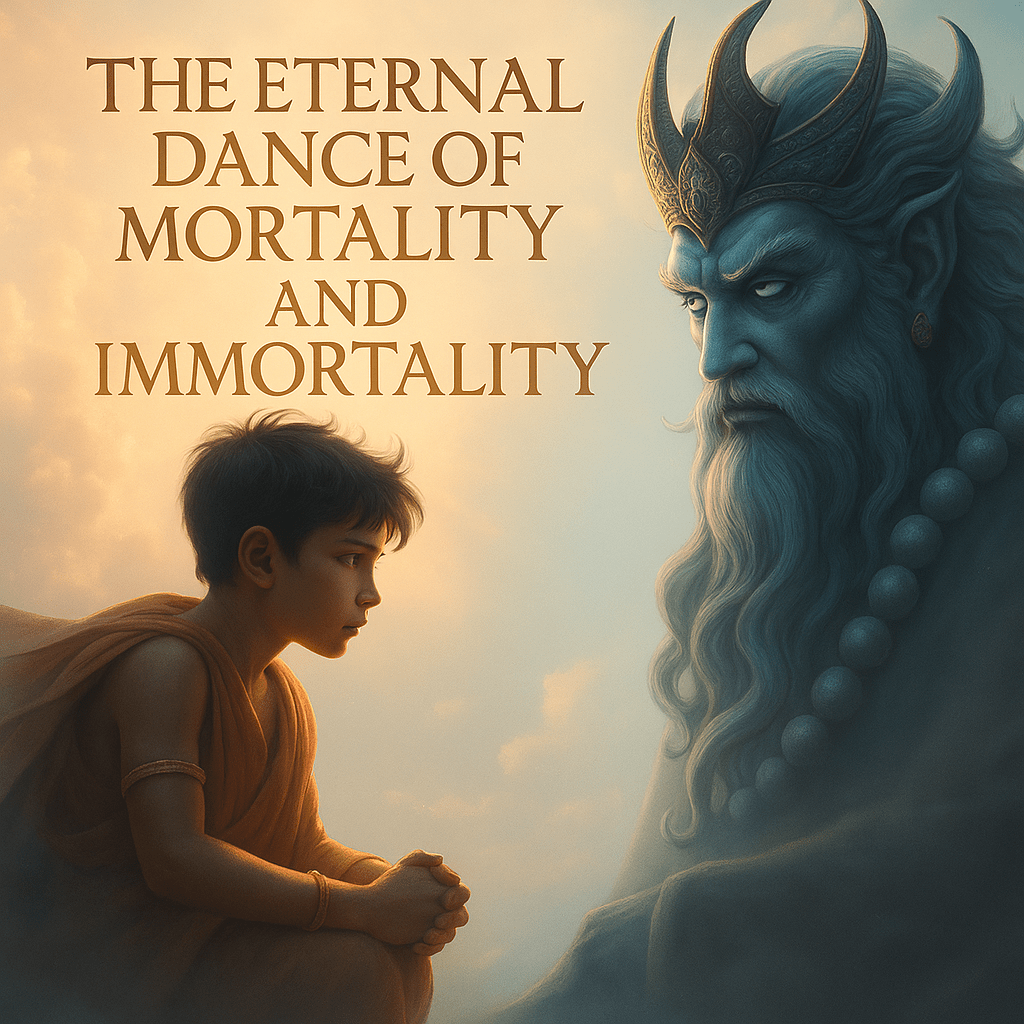

Among the eternal truths whispered across the universe lies the profound dialogue between Nachiketa, the fearless seeker, and Yama, the Lord of Death. This timeless exchange, chronicled in the “Katha Upanishad”, delves into humanity’s deepest questions: What is the nature of existence? What lies beyond death? And what is the essence of the Self?

Nachiketa, standing undaunted at the threshold of mortality, rejects the fleeting lures of wealth and power, insisting on understanding the ultimate truth. Yama, the enigmatic custodian of life’s final mystery, tests the boy’s resolve but ultimately unveils the wisdom sought by sages across eons. Their conversation transcends the temporal, guiding us from the illusions of the material world to the boundless reality of the Self.

In the poem below, the essence of this dialogue is distilled, offering a glimpse into the eternal dance of mortality and immortality; a journey where death becomes the doorway to life’s ultimate liberation.

At death’s threshold, a boy stood still,
Unshaken by fear, with an iron will.
“O Keeper of Time,” his voice rang clear,
“Reveal the truth all beings fear.

What lies beyond this fleeting life?
Beyond the joy, the pain, the strife?
What is the Self that knows no end,
The truth where birth and death transcend?”

Yama, with eyes of infinite flame,
Spoke of paths both peril and fame.
“O seeker bold, so rare, so wise,
Few pierce the veil where illusion lies.

The world, a stage of transient play,
Its treasures fade, its joys decay.
The senses beguile, the mind enchains,
Binding the soul to pleasures and pains.

Yet beyond this maze of fleeting gleam,
Lies the truth beyond the dream.
The Self, eternal, still, and pure,
Unborn, undying, forever sure.

Life flows like rivers, swift and vast,
Desires its currents, never to last.
But the Self is the ocean, deep and wide,
Untouched by the storms of time and tide.

O child of courage, turn within,
Seek the flame untouched by sin.
The body fades, the mind dissolves,
Yet the Self remains as life evolves.

Death is but a fleeting door,
To worlds unseen, to the evermore.
The wise see death as the soul’s release,
A merging with the eternal peace.

Cast off the fleeting, the shadowed gold,
And grasp the truth, so still, so bold.
For the Self is light, the source divine,
The boundless essence, eternally thine.”

Nachiketa, with heart alight,
Beheld the truth beyond the night.
The veils of maya torn asunder,
He stood in awe of the cosmic wonder.

The discourse between Nachiketa and Yama is more than a dialogue; it is a mirror to the human soul, reflecting our deepest aspirations and fears. Nachiketa’s unwavering resolve exemplifies the courage needed to confront life’s ultimate questions, while Yama’s wisdom offers a path to transcendence.

In their exchange lies a profound truth: life and death are not opposites but complementary forces in the eternal dance of existence. To cling to the fleeting is to suffer; to renounce it is to be free. The Self, unchanging and infinite, awaits discovery beneath the illusions of the material world.

This timeless teaching reminds us that the journey is not outward but inward. Like Nachiketa, we are called to confront the impermanence of life, to strip away desires that bind, and to awaken to the eternal light of the Self. For in embracing mortality, we find the key to immortality.


 Addy's Verse
Leave a comment