“Aguner Parashmoni Chhoyao Prane,” a revered Rabindra Sangeet composed by Rabindranath Tagore in 1914, is a profound expression of spiritual yearning and self-surrender. Written during Tagore’s stay in Surul, near Sriniketan, the song emerged amidst his engagement with agricultural and scientific pursuits.
On August 28, 1914, while teaching new compositions to his nephew Dinendranath Tagore, Rabindranath crafted this piece, later published in the magazine Probasi as part of the Gitali collection. Belonging to the Puja (worship) category in Geetabitan, it is the 212th song and serves as the customary inaugural piece for the Rabindrasangeet Sammelan Parishad.
The song’s lyrics, set to the Kedara raga and Teental rhythm, evoke a prayer for purification through the metaphorical “Touchstone of Fire,” symbolizing divine enlightenment that sanctifies life amidst sorrow. Its imagery of light piercing darkness and pain transforming into transcendence resonates deeply, reflecting Tagore’s philosophical blend of devotion and resilience.
O spark divine, ignite my soul’s deep core,
A flame to burn where shadows softly creep.
Let life’s frail husk ascend, no longer weep,
And glow as embers on a sacred shore.
Through veils of night, your radiant touch I seek,
To carve in light what darkness dares to bind.
My heart, a lamp, forever intertwined,
Burns fierce where mortal fears grow faint and weak.
In sorrow’s forge, my spirit learns to rise,
Each pang a star that kindles endless skies.
Your fire, O truth, consumes my fleeting pain,
And bids my song through boundless dawns to soar.
I offer all, my breath, my joy, my all,
To shine eternal, touched by flame once more.
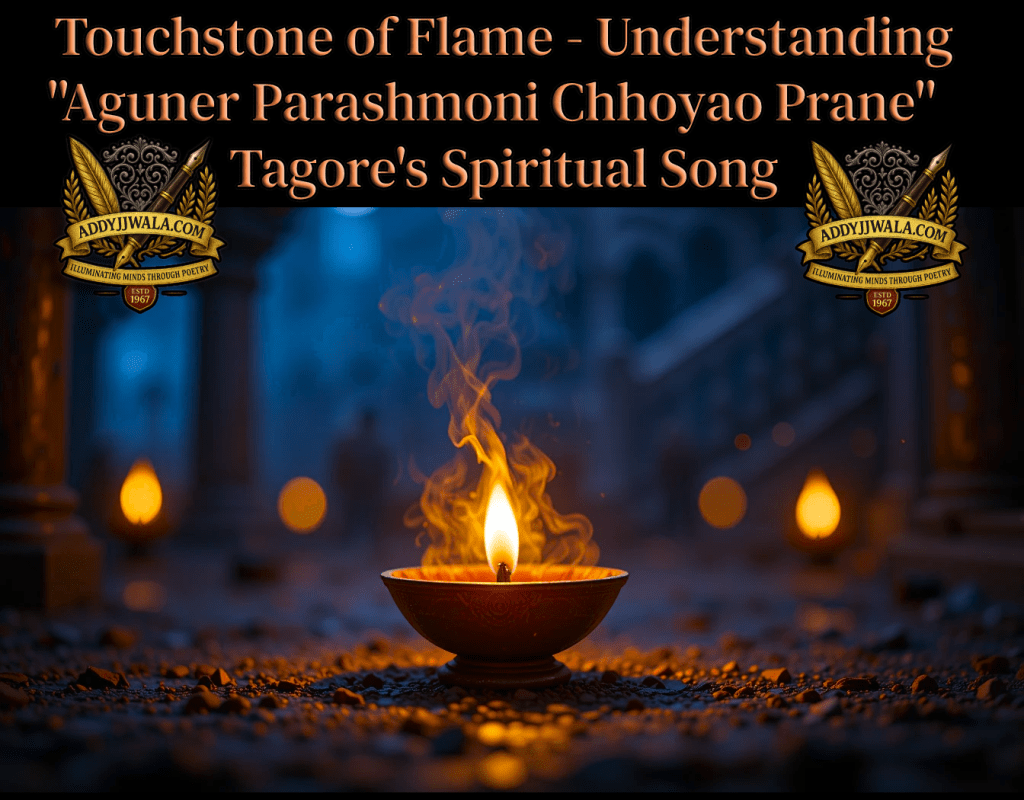
The poem Touchstone of Flame draws inspiration from the spiritual depth of “Aguner Parashmoni Chhoyao Prane,” capturing its essence as a prayer for transformation through divine fire. Tagore’s original work, rooted in his 1914 reflections, speaks to the universal human quest for meaning beyond suffering, a theme echoed in the poem’s imagery of light, fire, and transcendence.
The song’s historical significance, as a cornerstone of Rabindra Sangeet and a beacon of Bengali cultural heritage, underscores its enduring power to inspire across generations. Its call to sanctify life through surrender remains as relevant today as it was over a century ago, inviting listeners and readers alike to find solace in the eternal flame of truth.
NOTE
I have always cherished the works of the great Rabindranath Tagore. In my humble efforts, I have been attempting to translate his creations so that those who do not understand Bengali may still catch a glimpse of the beauty and depth they hold.
I believe that a song becomes far more enriching when one understands the meaning it seeks to convey through its lyrics.
I am but a speck of dust before the towering genius of the indomitable Rabindranath Tagore, and I offer my translations with utmost reverence. I sincerely apologize in advance for any errors or shortcomings. Kindly point them out, so that I may correct them and strive toward a more faithful rendering.


 Addy's Verse
Leave a comment