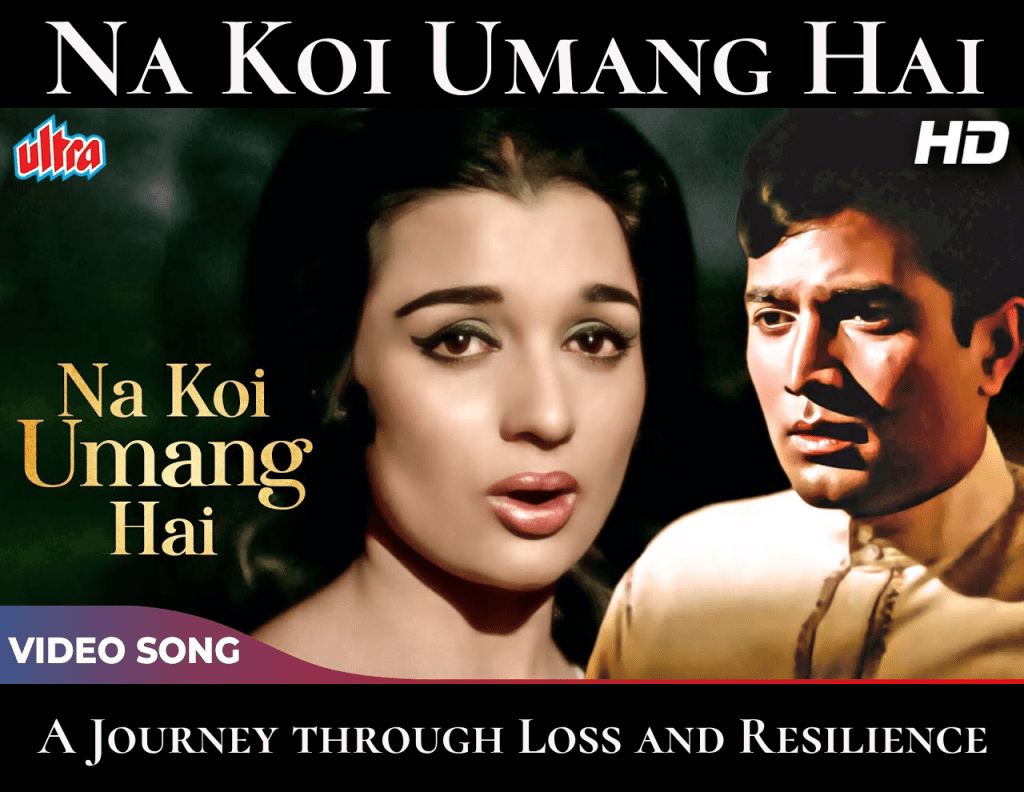
The song Na Koi Umang Hai from the 1970 film Kati Patang beautifully illustrates loss and resilience through the story of Madhavi, portrayed by Asha Parekh, who presents herself as a widow to escape her past, while Rajesh Khanna plays her compassionate love interest. The narrative, based on Gulshan Nanda’s novel, delves into love, redemption, and societal judgment. With lyrics by Anand Bakshi and music by R.D. Burman, Lata Mangeshkar’s emotive voice captures Madhavi’s sorrow, creating a haunting yet beautiful atmosphere.
This poem reflects on human fragility and the emotions of personal tragedy while celebrating resilience, enhanced by the film’s music as a memorable part of Indian cinema.

What is this life, but a severed thread,
A kite that soared, now cast and dead?
Once kissed by winds of tender embrace,
Now left to wander, bereft of grace.

Does the world not heed the silent plea,
Of a soul adrift on a waveless sea?
Its tether snapped, its anchor lost,
A fragile dream in the tempest tossed.

Carried aloft, the wedding bells tolled,
Yet their melody chilled like a story old.
A palanquin lifted, no joy to bestow,
A dirge for a bride with a heart hollow.

When I fell to the earth, the vultures came,
To feast on my sorrow, to mock my name.
Their claws, unkind, tore my spirit apart,
Leaving but remnants of a fractured heart.

O Lord of my dreams, what offering shall suffice?
From autumn’s shadow, where mourners’ songs entice.
A mirror of tears reflects my soul’s despair,
Casting hues of sorrow through twilight’s somber air.

Can a sundered kite reclaim the sky,
When its dance is stilled and dreams run dry?
Or does it spiral, bereft and torn,
A silent witness to a day unborn?
Kati Patang explores the pain of a disconnected life, paralleling the protagonist’s struggle to that of a kite cut from its string, revealing a poignant beauty in the desire for redemption and connection. The poem reflects on life’s vulnerability and the relentless hope within the human spirit despite adversity.
 Addy's Verse
Leave a comment