Hindu cosmology presents an awe-inspiring vision of the universe, transcending the confines of linear time and limited space. Ancient scriptures such as the Vedas, Upanishads, Puranas, and the Bhagavad Gita describe a multiverse where countless worlds and universes co-exist, each following its own rhythm of creation, sustenance, and dissolution. In this vision, time is cyclical rather than linear, measured in massive epochs called Yugas and cosmic cycles such as kalpas (4.32 billion years). The span of Lord Brahma’s life, The Cosmic Creator, lasts over 311 trillion years, and with each passing of his day and night, universes are born and destroyed.
This profound understanding doesn’t stop at just one universe but expands into multiple dimensions. The concept of loka or realms, reveals a layered reality, with planes higher than our material existence, like Svargaloka (Heaven) and Brahmaloka, as well as lower realms like Patalaloka (underworld). The soul’s journey, governed by the laws of karma and reincarnation, spans across these realms in countless lifetimes, giving each being an opportunity to evolve spiritually through experience and wisdom.
Creation, maintenance, and destruction form the essence of The Trimurti; Lord Brahma, Lord Vishnu, and Lord Shiva; each playing a role in the cyclical dance of existence. This dynamic process reveals the interplay between order and chaos, time and eternity, and light and shadow. Life is not seen as a single path, but as a mosaic of infinite possibilities, where countless universes coalesce, dissolve, and renew. This is the grand cosmic tapestry envisioned by Hindu seers; one where reality is far deeper than what meets the eye.
In this poem, titled “Cosmic Symphony: Cyclical Creation, Destruction and Rebirth in Hinduism,” I explore the mysticism of these timeless ideas: the eternity of time, the plurality of worlds, and the eternal dance of creation and dissolution.
Beyond the stars, beyond the night,
Lies realms unseen by mortal sight.
Infinite worlds in an endless dance,
A cosmic web of fate and chance.
The Vedas sing of truths untold,
Of multiverses, vast and bold.
Lord Brahma’s dream that wakes and fades,
Where time renews and never stays.
A kalpa’s breath, 4.32 billion years ,
A blink within the cosmic gears.
Universes rise, universes fall,
Creation’s rhythm, embracing all.
In Lord Shiva’s trance, destruction flows,
Yet from the ashes, life still grows.
Lord Vishnu drifts on the cosmic sea,
Preserving all that’s yet to be.
Each realm is layered, planes so wide,
Where gods and mortals both abide.
Beyond the earthly, subtle spheres;
Dimensions spun from hopes and fears.
Some worlds are bright, with light divine,
Others in shadows intertwine.
Higher realms where devas play,
Lower realms where karmas weigh.
Endless cycles turn and spin,
Life reborn from where it’s been.
The Maha Yuga takes its course,
Creation’s breath, the primal force.
What’s real? What’s a dream? No one can say,
As universes weave and sway.
The soul’s journey has just begun,
Across dimensions, one by one.
Time here bends, space folds in two;
No end, no start, just passing through.
The truth lies not in what we see,
But in the dance of eternity.
Thus, the cosmos sings its song,
With rhythms ancient, deep, and strong.
In silence vast or hymns divine,
All is fleeting, yet all is time.
Conclusion
The cosmic narrative of Hinduism reflects a reality that is boundless, interconnected, and cyclical. It teaches that life is eternal, not constrained by the limitations of one birth or one world. Just as universes expand and collapse, the soul journeys through dimensions and realms, growing and evolving over countless lifetimes. This perspective offers both humility and hope; humility, because we are part of something infinitely larger than ourselves; and hope, because even destruction is but a prelude to renewal.
The grand dance of creation, maintenance, and dissolution reminds us that nothing truly ends; everything is constantly transforming. In this vision, time is not a straight line but a circle, eternally turning. The individual and the cosmos are intertwined, reflecting each other’s essence. Life’s deeper purpose is not merely to exist but to experience, learn, and awaken to the interconnectedness of all that is.
This journey across universes, lifetimes, and dimensions tells us that our story is never truly over. Like stars that are born from cosmic dust, we too shall rise again; each time closer to the truth, each step a part of the eternal symphony of existence.
Alphabetical Glossary of Terms in Hindu Cosmology and the Poem “Cosmic Symphony: Cyclical Creation, Destruction and Rebirth in Hinduism”
- Atman
The individual soul or essence, believed to be a fragment of the universal Brahman. The realization of the unity between Atman and Brahman is key to attaining Moksha (liberation). - Lord Brahma
The Creator God in Hinduism, responsible for bringing the universe into existence. His life spans 311 trillion years, with each kalpa (day) lasting 4.32 billion years. - Brahman
The infinite, formless, and all-pervading reality that is the source of everything. Brahman is the ultimate essence behind all existence and beyond ordinary perception. - Brahmaloka
The highest realm of existence, where souls that achieve unity with Brahma reside. It is considered the final plane before the dissolution of individuality. - Cosmic Sea (Ksheer Sagar)
A mythological ocean where Lord Vishnu rests on the serpent Shesha Naga symbolizing cosmic order. It represents the preservation of potential creation and sustenance. - Devas
Divine beings or celestial entities that represent cosmic forces such as light, air, and fire. They inhabit higher realms like Svarga Loka. - Kalpa
A cosmic day in the life of Brahma, spanning 4.32 billion years. It marks one full cycle of the creation, preservation, and dissolution of the universe. - Kalpa’s Breath
A poetic metaphor referring to the vast expanse of cosmic time, where a day (kalpa) is compared to a fleeting breath in eternity’s endless rhythm. - Karma
The universal law of cause and effect, where every action influences future outcomes, whether in this life or the next. Karma governs the cycle of reincarnation (samsara). - Loka
A realm or plane of existence in Hindu cosmology. The universe is divided into multiple lokas arranged vertically. A few of the Lokas are as follows.
- Svargaloka: Heaven, where gods and divine beings reside.
- Patalaloka: Underworld, inhabited by serpents and demonic beings.
- Brahmaloka: The highest spiritual realm.
- Mahā Yuga
A grand cycle lasting a whopping 4,320,000 years comprising of the following four epochs (yugas):
- Satya Yuga: The age of truth and virtue lasts for 1,728,000 years.
- Treta Yuga: The age of diminished righteousness lasts for 1,296,000 years.
- Dvapara Yuga: A further decline in morality lasts for 864,000 years.
- Kali Yuga: The current age, marked by darkness and decay of virtues lasts for 432,000 years.
- Moksha
Spiritual liberation or freedom from the endless cycle of birth, death, and rebirth (punarjanam or samsara). It signifies unity with Brahman and the end of individual suffering. - Multiverse
The concept of multiple, co-existing universes, each governed by its own time cycles. Hindu cosmology hints at this idea with the notion of endless realms and creations. - Patala Loka
A subterranean realm in Hindu cosmology, often associated with demons (asuras) and serpents (nagas). It is one of the lower realms in the cosmic hierarchy. - Puranas
Ancient Hindu texts containing mythology, cosmology, and the genealogies of gods and sages. They describe the cycles of creation and offer insights into divine stories. - Reincarnation (Punarjanam or Samsara)
The cycle of birth, death, and rebirth. A soul, bound by karma, journeys across lifetimes and realms until it achieves moksha (liberation). - Satya Yuga
The first and purest of the four yugas, marked by truth, righteousness, and spiritual wisdom. It is also known as the Golden Age. - Lord Shiva
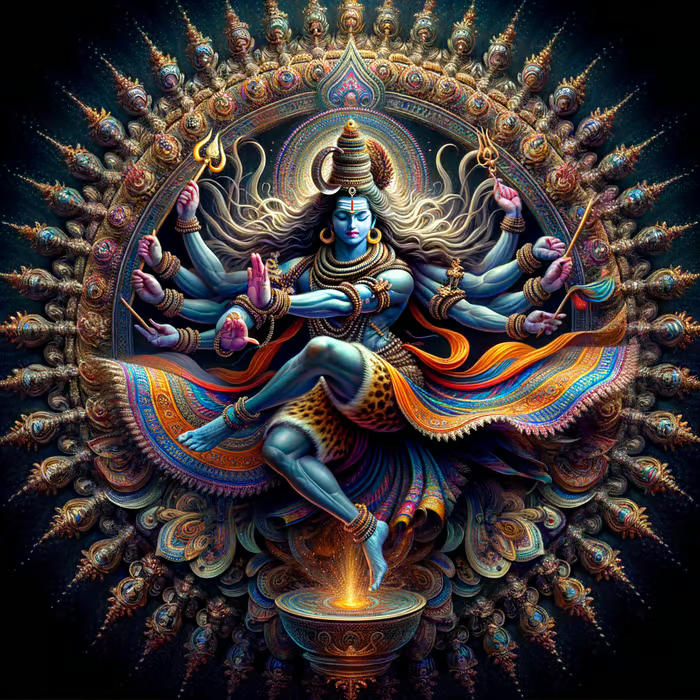
The destroyer and transformer among the Trimurti. His dance, known as Tandava, represents the dynamic process of destruction and renewal. - Lord Shiva’s Dance (Tandava)
A symbolic cosmic dance performed by Shiva, representing the simultaneous forces of creation, preservation, and destruction. It emphasizes the cyclical nature of time. - Soul’s Journey
The process through which the atman (soul) travels across lifetimes, dimensions, and realms, experiencing growth and learning until it achieves liberation (moksha). - Svargaloka
The heavenly realm where Gods (Devas) reside. It is a place of joy, but souls do not stay there eternally, as they must return to the cycle of rebirth based on their karma. - Trimurti
The Trinity of Hindu gods who govern the cyclical nature of the universe:
- Lord Brahma: The Creator.
- Lord Vishnu: The Preserver.
- Lord Shiva: The Destroyer and Transformer.
- Upanishads
Philosophical texts that elaborate on the spiritual ideas found in the Vedas. They focus on self-realization, the nature of reality, and the path to liberation (moksha). - Vedas
The oldest and most sacred texts of Hinduism, comprising hymns, rituals, and philosophical teachings. They serve as the foundation of Hindu religious thought and cosmology. - Lord Vishnu
The Preserver God, responsible for maintaining the order of the universe. He incarnates in various forms (avatars) to restore balance when chaos threatens creation.
Hindu Scriptures: Timeless Truths, Not Colonial Myths
Hindu religious scriptures stand as profound repositories of spiritual wisdom, metaphysical truths, and scientific insights, not mere myths or fanciful tales. The Vedas, Upanishads, Puranas, and epics like the Mahabharata and Ramayana encompass a wealth of knowledge that spans philosophy, astronomy, mathematics, and medicine. They assert groundbreaking ideas such as the multiverse, cyclical time, atomic theory, and consciousness, many of which resonate with or even precede modern scientific discoveries. These texts exemplify a sophisticated worldview that views the universe’s creation, sustenance, and dissolution as an integral part of a dynamic, eternal cycle; a reality that transcends the limited linear narrative of history presented by Western colonial frameworks. The wisdom embedded in these scriptures has expertly guided generations of seekers toward self-realization and societal harmony, nurturing the world’s oldest civilization.
During the colonial period, European colonizers and missionaries intentionally misrepresented Hindu scriptures as mere mythology to undermine the confidence and cultural identity of the Hindu populace. Labeling these sacred texts as “myth” was a strategic tool of cultural demoralization, aimed at imposing foreign ideologies while portraying indigenous traditions as inferior. Yet, this dismissive narrative fails to acknowledge the profound depth and complexity of these texts, which provide vital insights into the nature of existence, consciousness, and the cosmos. Today, scientists, scholars, and spiritual practitioners around the globe recognize that Hindu scriptures embody timeless wisdom, essential not only for personal growth but also for understanding the universe. These texts are far from primitive stories; they offer invaluable insights into reality itself, encouraging humanity to transcend material illusions and grasp the deeper truths of existence.
Most so-called “inventions” flaunted by Western scientists during the colonial era and beyond are nothing but blatant acts of theft from ancient Hindu religious and scientific texts. The real kicker? In some instances, they’re being forced to confront this inconvenient truth! It’s only a matter of time before the whole facade crumbles. We’re just scratching the surface here; I plan to dissect this topic in gruesome detail another time. So, thanks for tuning in! If this ignites a fire in you, hit that like button and unleash your thoughts in the comments!
 Addy's Verse
Leave a comment