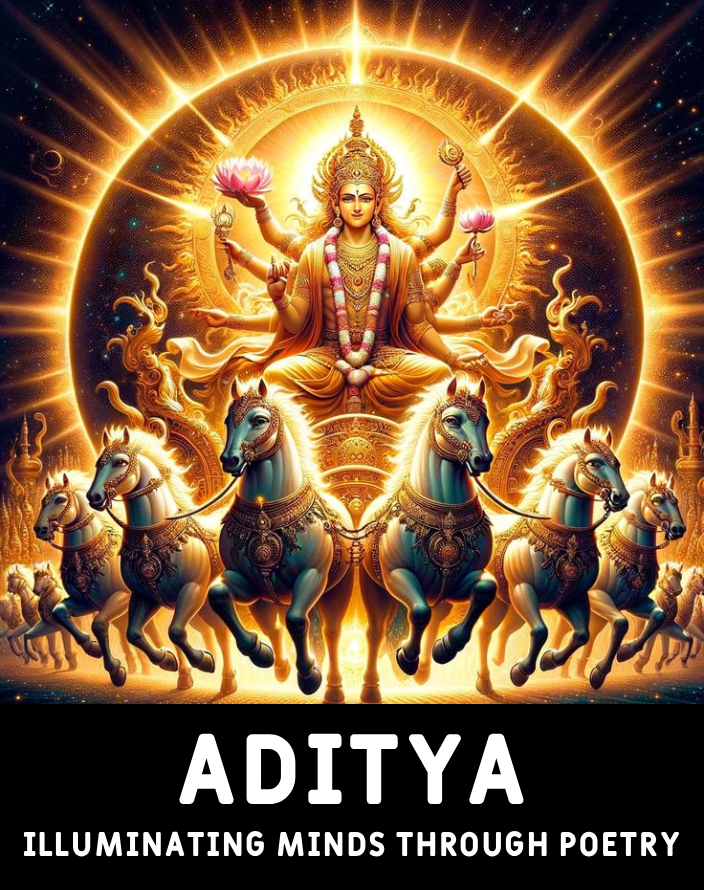
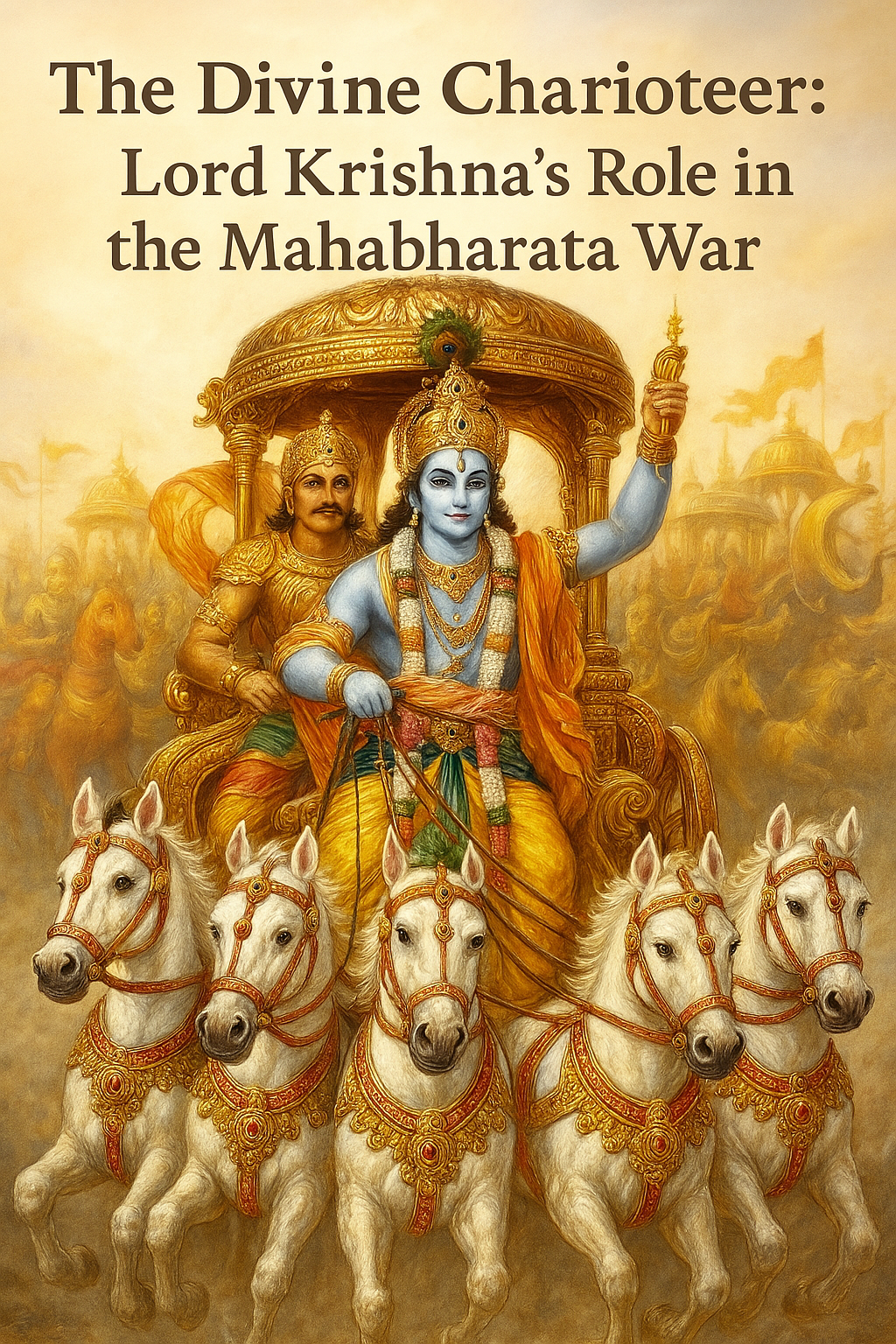
Lord Krishna, The Yogeshwar and Jagadguru (Teacher of the Universe), stands at the heart of the Mahabharata, not merely as Arjuna’s charioteer, but as The Supreme Guide Who illuminates the path of dharma. His presence transcends the battlefield of Kurukshetra, reflecting timeless wisdom that echoes through the Bhagavad Gita and resonates with the essence of the Vedas and Upanishads.
The Bhagavad Gita presents Shri Krishna as the Parabrahman, The unchanging force that manifests to restore balance:
“यदा यदा हि धर्मस्य ग्लानिर्भवति भारत।
अभ्युत्थानमधर्मस्य तदात्मानं सृजाम्यहम्॥”
(yadā yadā hi dharmasya glānir bhavati bhārata, abhyutthānam adharmasya tadātmānaṁ sṛijāmy aham)
— Bhagavad Gita 4.7
“Whenever dharma declines and adharma rises, I manifest myself, O Bharata.”
In the Upanishads, Lord Krishna’s essence is likened to the Atman, the Innermost Self that neither slays nor is slain. The Vedas describe This Divine Presence as the Prana (breath) of the universe; unseen but essential, binding all existence.
With reverence to Lord Jagannatha (Lord of the Universe), let us now explore His role in the Mahabharata war through a poetic tribute.
The sky trembles, and the war drums cry,
As dharma falters, kingdoms lie.
A chariot rolls through the battlefield vast,
And Lord Krishna arrives, both future and past.
No sword adorns His radiant hand,
Yet fate bows down to His command.
He wields not weapons, but words profound,
In silence, He makes the cosmos resound.
“Fear not, O Arjuna, the soul is free,
It neither perishes nor can it flee.
Shed these illusions of birth and decay,
Rise, and let courage light your way.”
Like the unseen breath that fuels the flame,
He whispers truths no time can tame.
For what is life but fleeting shade,
When duty’s call must be obeyed?
“Cast aside desire, shed all gain,
Victory or loss—both are vain.
In karma’s dance, act without chain,
For freedom lies beyond joy and pain.”
He shows Arjuna the cosmic sight—
Countless worlds within His might.
His Vishvarupa glimmers and shifts,
Where stars dissolve as time uplifts.
“I am Kaal, the all-consuming flow,
In me, even mighty warriors bow.
The end and beginning merge as one,
All battles fought beneath my sun.”
The arrows fly, yet none He aims,
His essence spreads through dharma’s flames.
A silent charioteer, He steers the soul,
Through action’s storm to the highest goal.
When night consumes the final breath,
And kings lie still, embraced by death,
Lord Krishna’s gaze still burns and stays—
A beacon through life’s tangled maze.
For He is within, the heart’s own voice,
Guiding each soul to make its choice.
Not bound by fear, nor joy, nor grief,
In His wisdom lies the soul’s relief.
When the dust of war fades from the air,
His truth lingers everywhere.
Through ages and hearts, His words remain—
“Rise, act, love—through pleasure or pain.”
This poem reflects Lord Krishna’s transcendental role in the Mahabharata. He does not merely guide Arjuna in war but leads him, and through him, all humanity; toward the realization of the Self. Lord Krishna’s teachings dismantle the illusion of opposites: victory and defeat, joy and sorrow, action and inaction. His message is timeless; to act without attachment, to love without possession, and to live without fear.
In His cosmic form as Kaal, Lord Krishna reveals that all beginnings and endings are held within Him, reminding us that time is but a fleeting expression of eternity. Through His wisdom, Lord Krishna shows that life’s journey is not toward an external goal but toward the discovery of the divine within; where the eternal charioteer waits patiently, ready to guide us through every storm.
Shlokas with Transliteration and Detailed Meaning
Bhagavad Gita 4.18
कर्मण्यकर्म यः पश्येदकर्मणि च कर्म यः।
स बुद्धिमान्मनुष्येषु स युक्तः कृत्स्नकर्मकृत्॥
Transliteration:
karmāṇy akarma yaḥ paśhyed akarmaṇi cha karma yaḥ
sa buddhi-mān manuṣhyeṣhu sa yuktaḥ kṛitsna-karma-kṛit
Meaning:
“He who sees inaction in action, and action in inaction, is wise among humans. He is integrated, performing all actions with true understanding.”
Context: Lord Krishna urges Aruna to see beyond surface appearances—what seems inactive may be profoundly active, and true action often hides within apparent stillness. The teaching encourages detachment from outcomes, revealing the deeper essence of karma.
Bhagavad Gita 11.33
तस्मात्त्वमुत्तिष्ठ यशो लभस्व जित्वा शत्रून् भुङ्क्ष्व राज्यं समृद्धम्।
मयैवैते निहता: पूर्वमेव निमित्तमात्रं भव सव्यसाचिन्॥
Transliteration:
tasmāt tvam uttiṣhṭha yaśho labhasva
jitvā śhatrūn bhuṅkṣhva rājyaṁ samṛiddham
mayaivāite nihatāḥ pūrvam eva
nimitta-mātraṁ bhava savya-sāchin
Meaning:
“Therefore, arise and attain glory. Conquer your enemies and enjoy a prosperous kingdom. They are already slain by Me—be merely the instrument, O Arjuna.”
Context: Lord Krishna emphasizes that the outcomes of the battle are preordained. Arjuna is called upon not to resist but to act as an instrument of Divine Will. This teaching reveals the illusory nature of control—that we are channels through which cosmic forces manifest.
Mundaka Upanishad 3.2.9
भिद्यते हृदयग्रन्थिः छिद्यन्ते सर्वसंशयाः।
क्षीयन्ते चास्य कर्माणि तस्मिन् दृष्टे परावरे॥
Transliteration:
bhidyate hṛidaya-granthiḥ chhidyante sarva-saṁśhayāḥ
kṣhīyante chāsya karmāṇi tasmin dṛiṣhṭe parāvare
Meaning:
“When the supreme truth is realized, the knot of the heart is loosened, all doubts are resolved, and the bonds of karma are destroyed.”
Context: This Upanishadic verse captures the liberating nature of self-realization, a state Lord Krishna guides Arjuna toward. The “knot of the heart” symbolizes ignorance, which dissolves when the divine within is perceived.
In the end, Lord Krishna is the inner charioteer within every heart, urging us to rise, act, and find peace in the pathless path of love, knowledge, and service. His teachings are not confined to the battlefield—they are blueprints for living authentically in the face of life’s trials. Through Lord Krishna, the finite merges with the infinite, and time dissolves into eternity.
This poem, laced with metaphor and depth, reminds us that the journey is not to win wars outside but to conquer the war within, with Krishna steering us toward the ultimate truth—where the self merges with the Self.
Glossary of Key Sanskrit and Hindi Terms in the Poem
This glossary provides a detailed understanding of key Sanskrit and Hindi words, metaphors, and spiritual concepts used in the poem and associated texts. Each entry is explained with contextual meanings to enrich the reading experience.
A
- Adharma (अधर्म):
Opposite of dharma; behavior that is unrighteous, immoral, or against the cosmic order. Adharma triggers the events of the Mahabharata war. - Arjuna (अर्जुन):
The central hero of the Mahabharata, a skilled archer and seeker of truth. Arjuna represents the human soul struggling between action and inaction, guided by Krishna toward enlightenment.
B
- Bhagavad Gita (भगवद्गीता):
The “Song of the Divine,” a profound and revered dialogue between Lord Krishna and Arjuna, which contains essential spiritual teachings on duty, action, and liberation. This sacred text serves as a philosophical guide, exploring the nature of reality, ethics, and the importance of righteous action. It forms part of the epic Mahabharata and is central to Hindu philosophy, influencing countless seekers and scholars throughout history. - Bhakti (भक्ति):
Devotion or surrender to the divine. In the Gita, Lord Krishna teaches that love and faith (bhakti) lead to union with the Supreme, emphasizing that through genuine devotion, one can transcend worldly attachments and align oneself with the cosmic order, fostering a deep spiritual connection and inner peace that resonates throughout one’s life journey. - Brahman (ब्रह्मन्):
The ultimate, formless reality in Vedanta philosophy, described as the source of all existence and beyond the limitations of time, space, and causation. Lord Krishna embodies both the personal God, allowing devotees to connect with a relatable deity, and the impersonal Brahman, representing the transcendent aspect of the divine that pervades all of reality. This duality offers a comprehensive understanding of divinity for practitioners of the philosophy.
C
- Charioteer (सारथी):
A metaphor for Lord Krishna as the divine guide who steers not just Arjuna’s chariot but also the mind and soul through life’s dilemmas. His role emphasizes the importance of guidance and wisdom in navigating the complexities of human existence, showcasing the profound relationship between the divine and the seeker as they journey through the battlefield of life, where decisions shape the course of destiny.
D
- Dharma (धर्म):
Righteousness, moral law, or duty. It represents the ethical and moral principles that govern an individual’s behavior and responsibilities within society. Lord Krishna urges Arjuna to follow his dharma as a warrior, highlighting the importance of fulfilling one’s duties without attachment to personal loss or gain, emphasizing that adhering to one’s dharma leads to harmony and balance in the universe. - Detachment (वैराग्य – Vairagya):
The principle of non-attachment to the results of actions, which emphasizes the importance of maintaining a balanced mindset regardless of external circumstances. Lord Krishna teaches this as the key to inner peace, illustrating that true happiness arises not from outcomes but from the quality of our actions and intentions. Embracing this philosophy can lead to profound personal growth and resilience in the face of life’s challenges.
G
- Guru (गुरु):
A spiritual teacher who removes ignorance. Lord Krishna, as Arjuna’s guru, provides wisdom that transcends the battlefield.
J
- Jagannatha (जगन्नाथ):
Literally “Lord of the Universe.” This name emphasizes Lord Krishna’s cosmic nature, guiding both worldly events and inner journeys, serving as a reminder of the divine presence that encompasses all aspects of life, invoking a sense of peace and interconnectedness among all beings. - Jnana (ज्ञान):
Knowledge or wisdom that leads to self-realization, allowing one to discern the nature of reality. Lord Krishna emphasizes that true knowledge is knowing the unity of all things, transcending the illusion of separateness that pervades human experience. This understanding fosters a profound sense of connection with the universe and a deep inner peace.
K
- Kaal (काल):
Time personified. Lord Krishna, in His Vishvarupa (universal form), reveals Himself as Kaal, showing that He is the ultimate force behind creation and destruction. - Karma (कर्म):
Action or deed, with consequences tied to the law of cause and effect. Lord Krishna teaches Arjuna to act selflessly, without attachment to outcomes, emphasizing the importance of performing one’s duty with devotion and integrity. This philosophical concept highlights that every action influences future circumstances, shaping one’s destiny and reinforcing the interconnectedness of all beings. - Karma Yoga (कर्म योग):
The path of selfless action performed as a service to the divine, emphasizing the importance of performing one’s duty without attachment to the results. Lord Krishna advises Arjuna to engage in Karma Yoga to achieve liberation, highlighting that through such actions, one can attain spiritual growth and align with the universal flow of life.
M
- Maya (माया):
The illusion or cosmic delusion that obscures the true nature of reality, often described as a veil that clouds human perception and understanding. Lord Krishna’s teachings help Arjuna transcend the veil of Maya, empowering him to recognize and see beyond the illusions that distract from spiritual truth and clarity. Through this guidance, Arjuna learns to navigate the complexities of life with awareness and insight, ultimately leading toward enlightenment and liberation. - Moksha (मोक्ष):
Liberation from the cycle of birth, death, and rebirth (samsara). Lord Krishna shows the path to moksha through knowledge, action, and devotion, emphasizing the importance of understanding one’s true nature and the universe, while advocating for selfless service and fostering a deep sense of connection with the divine. This ultimate goal is often pursued by following various spiritual disciplines and practices aimed at transcending worldly attachments.
N
- Nishkama Karma (निष्काम कर्म):
Action performed without any expectation of reward, where individuals engage in their duties selflessly and selflessly contribute to the welfare of others. Lord Krishna emphasizes this as the ideal way to act, as it not only purifies one’s mind but also frees the soul from bondage and leads to spiritual growth and enlightenment. Adopting this philosophy helps individuals transcend their ego and develop a deeper connection with the universe.
P
- Pandavas (पाण्डव):
The five brothers, including Arjuna, who fight for justice and dharma in the epic Mahabharata, embody the values of loyalty, honor, and perseverance. They represent the triumph of righteousness over evil, facing numerous challenges and adversaries throughout their journey, ultimately striving to restore peace and order in the kingdom. - Parabrahman (परब्रह्मन्):
The Supreme Absolute, which transcends all forms and dualities, is often conceived as the ultimate reality in various philosophical traditions. Lord Krishna, as the divine being, embodies both the personal and impersonal aspects of Parabrahman, representing an integration of all existence and non-existence, and serving as a bridge between the material and spiritual worlds, thereby offering a path for seekers to understand and experience this profound truth.
S
- Samsara (संसार):
The endless cycle of birth, death, and rebirth, which is central to various philosophies and religions. Lord Krishna’s teachings aim to guide the soul out of samsara toward eternal peace and liberation, emphasizing the importance of dharma (righteousness) and devotion in overcoming the material struggles of life. Through understanding one’s true nature and engaging in selfless actions, one can transcend the cycle and attain a state of ultimate bliss and enlightenment. - Sannyasa (संन्यास):
Renunciation of worldly desires and the relinquishing of personal attachments. Lord Krishna encourages internal renunciation; detachment while performing one’s duties in the world, emphasizing the importance of maintaining focus on one’s spiritual practice while engaging in everyday responsibilities and interactions. This path leads to true liberation and peace of mind, allowing practitioners to transcend the dualities of pleasure and pain inherent in material existence. - Shloka (श्लोक):
A verse, often found in sacred texts like the Bhagavad Gita, Vedas, and Upanishads. Each shloka conveys profound spiritual wisdom.
U
- Upanishads (उपनिषद्):
Philosophical scriptures that explore the nature of the self and the ultimate reality, comprising a rich tapestry of meditative and contemplative thought. Many of Lord Krishna’s teachings in the Gita draw from Upanishadic insights, emphasising self-realisation and the interconnectedness of all existence. They serve as a guiding light for seekers on the spiritual path, urging individuals to transcend worldly attachments and attain a higher state of consciousness.
V
- Vairagya (वैराग्य):
Dispassion or detachment from material desires is a profound concept in spiritual traditions. Lord Krishna teaches vairagya as essential for attaining inner peace and spiritual growth, emphasizing that by renouncing attachment to worldly objects and outcomes, one can cultivate a deeper sense of connection with the divine and experience true liberation. This state of being allows individuals to navigate life’s challenges without being swayed by emotional turbulence, ultimately leading to a serene existence and the realization of one’s higher self. - Vedas (वेद):
The most ancient scriptures of Hinduism, containing hymns, rituals, and philosophical teachings that have been revered for millennia. These texts encompass a vast array of knowledge and insights about life, the universe, and the divine. Lord Krishna, as the embodiment of divine wisdom, upholds the truths of the Vedas, guiding practitioners in their spiritual journey and reinforcing the significance of these sacred writings in the spiritual landscape of Hinduism. - Vishvarupa (विश्वरूप):
The universal form of Lord Krishna, in which He reveals Himself as the source of all creation, destruction, and time. This extraordinary vision transcends human perception, showcasing His divine omnipresence, which is both awe-inspiring and humbling. Through this magnificent form, devotees are granted a profound glimpse into the vastness of existence, emphasizing the infinite nature of divinity and the intricate interconnection of all living beings within the cosmic play. The experience of witnessing Vishvarupa deeply transforms the hearts and minds of those fortunate enough to behold it, instilling a sense of reverence, devotion, and understanding of the cosmic order that governs all life. A more detailed explanation is given at the end.
Y
- Yoga (योग):
A spiritual discipline aimed at uniting the individual soul (atman) with the divine. Krishna introduces multiple yogas in the Gita, including karma yoga (path of action), bhakti yoga (path of devotion), and jnana yoga (path of knowledge), each offering unique insights and practices for spiritual growth and personal transformation. The significance of yoga extends beyond mere physical exercise, highlighting its philosophical underpinnings and its role in fostering a profound connection between the self and the universe. - Yogeshwar (योगेश्वर):
The Lord of Yoga. Krishna, as Yogeshwar, exemplifies perfect mastery over action, devotion, and wisdom, serving as a guiding light for those seeking enlightenment. Through his teachings, he inspires countless individuals to find their true path and achieve self-realization in the journey of life.
Conclusion
This glossary captures the philosophical depth and spiritual richness of the Sanskrit and Hindi terms used in the poem and the Bhagavad Gita. By understanding these terms, readers can better appreciate the profound symbolism in Krishna’s teachings and His role in guiding humanity toward liberation.
Vishwarupa: The Cosmic Form of Krishna
The Bhagavad Gita, a sacred text within the Mahabharata epic, presents one of the most profound and awe-inspiring concepts in Hindu mythology: the Vishwarupa. This cosmic form of Lord Krishna, revealed to his disciple Arjuna during the tumultuous battle of Kurukshetra, offers a glimpse into the divine nature of the universe and the interconnectedness of all existence.
Arjuna, overwhelmed by the prospect of killing his own kin, is filled with doubt and despair. He questions the morality of war and his own ability to fulfill his duty as a warrior. In his moment of crisis, Lord Krishna, his charioteer and divine counselor, reveals his true nature, a vision that transcends the limitations of human comprehension.
The Vishwarupa is a spectacle of infinite power, knowledge, and beauty. Lord Krishna’s form, described as a vast, radiant expanse, encompasses the entire cosmos within itself. It is a vision of countless worlds, beings, and gods, all interconnected and sustained by the divine presence. The cosmic form is a symbol of the ultimate reality, the source of all creation and the sustainer of all existence.
The significance of the Vishwarupa extends far beyond the immediate context of the Bhagavad Gita. It offers a profound meditation on the nature of divinity, the interconnectedness of all things, and the ultimate purpose of human existence. The vision instills in Arjuna, and in the reader, a sense of awe, wonder, and humility.
Key aspects of the Vishwarupa include:
- Infinite Power: Lord Krishna’s cosmic form demonstrates his limitless power, capable of controlling the universe and its myriad beings.
- Cosmic Unity: The Vishwarupa reveals the interconnectedness of all existence, from the smallest atom to the vastest galaxy.
- Divine Knowledge: Lord Krishna’s form is a symbol of infinite wisdom and understanding, encompassing the past, present, and future.
- Spiritual Enlightenment: The vision of Vishwarupa can lead to spiritual enlightenment, as it offers a glimpse into the ultimate nature of reality.
The revelation of the Vishwarupa is a transformative moment in the Bhagavad Gita. It is a testament to the divine nature of Lord Krishna and the profound teachings of the sacred text. The vision invites us to contemplate the mysteries of the universe, the nature of our own existence, and the ultimate purpose of life. It is a reminder of the interconnectedness of all beings and the divine plan behind creation.


 Addy's Verse
Leave a reply to Aditya Jhunjhunwala Cancel reply